The idea of going from full-time glasses to clear, unaided vision within a single month is genuinely appealing — and in some cases, it is entirely achievable. But “some cases” is the important qualifier. The internet is full of claims that eye exercises, herbal remedies, or dietary changes can eliminate your prescription in weeks. Those claims do not hold up under clinical scrutiny. What does work, and what can realistically deliver spectacle-free vision within 30 days, is laser vision correction — provided you are a suitable candidate.
This guide separates fact from wishful thinking. We cover the surgical options that can remove your dependence on glasses within a month, explain why natural methods have biological limits, walk through the eligibility criteria you need to meet, and give you an honest timeline for each approach. If you have been searching for a way to reduce your eye power permanently, this is where realistic planning begins.
Key Takeaways
- Laser procedures like LASIK, SMILE Pro, and Contoura Vision can deliver spectacle-free vision within 24–72 hours — well within a one-month timeframe.
- Eye exercises, dietary changes, and home remedies may support general eye health but cannot reverse a refractive error or eliminate the need for glasses.
- Eligibility for laser surgery depends on age (18+), prescription stability, corneal thickness, and overall eye health — not just the desire to ditch glasses.
- A thorough pre-operative evaluation is the essential first step; without it, no credible timeline can be given.
Can You Really Remove Spectacles in One Month?
Yes — but only through surgical vision correction, not through exercises or supplements. Refractive errors like myopia (nearsightedness), hyperopia (farsightedness), and astigmatism are caused by the physical shape of your eyeball or cornea. No amount of palming, blinking drills, or carrot juice changes the axial length of your eye or the curvature of your cornea. These are structural measurements, not muscular weaknesses.
What laser eye surgery does is reshape the cornea so that light focuses correctly on the retina — achieving the same optical effect as your glasses, but permanently built into your eye. Most patients see clearly within 24 hours of the procedure and are fully stable well within one month. If your goal is genuinely to be free of spectacles within 30 days, a comprehensive eye evaluation is the only credible starting point.
Surgical Options That Work Within 30 Days
LASIK (Laser-Assisted In Situ Keratomileusis)
LASIK remains the most widely performed refractive surgery worldwide. A femtosecond laser creates a thin corneal flap, the excimer laser reshapes the underlying tissue to correct your prescription, and the flap is repositioned. The procedure itself takes under 10 minutes per eye, and most patients return to work within one to two days. Visual recovery is rapid — many people notice dramatically clearer vision within hours.
SMILE Pro
SMILE Pro is a flapless, keyhole procedure that corrects myopia and astigmatism by extracting a tiny lenticule from inside the cornea through a 2–4 mm incision. Because there is no flap, it preserves more corneal structural strength and is particularly well-suited for people in physically active professions. Recovery is similarly fast.
Contoura Vision (Topography-Guided LASIK)
Contoura Vision maps 22,000 unique points on your corneal surface and customises the ablation profile to correct not just your prescription but also micro-irregularities invisible to standard refraction. This often delivers sharper visual quality than conventional LASIK. It is an excellent choice for patients with subtle astigmatism or irregular corneal surfaces.
Innoveyes (Wavelight Plus)
The latest addition to our technology platform, Innoveyes uses AI-driven biometric modelling to create a digital twin of your eye, enabling a level of surgical personalisation that goes beyond standard topography-guided treatments. It is especially relevant for complex or borderline cases where precision matters most.
TransPRK (For Those Who Cannot Have LASIK)
If your cornea is too thin for LASIK or SMILE Pro, TransPRK reshapes the cornea directly from the surface without any flap or incision. Recovery is slower — functional vision typically returns within five to seven days — but it conserves the most tissue. You can still comfortably be spectacle-free within one month.
Do Natural Methods Actually Work?
This is where honesty matters more than optimism. Methods commonly promoted online — eye exercises, palming, the Bates method, amla juice, almond-fennel mixtures, ghee massage, walking barefoot on grass — have no peer-reviewed clinical evidence supporting their ability to reverse a refractive error. These claims persist because they are appealing and low-cost, not because they are effective.
What Natural Habits Can Do
A nutrient-rich diet (especially foods high in vitamin A, C, E, and omega-3 fatty acids), regular screen breaks using the 20-20-20 rule, adequate sleep, and UV-protective eyewear all contribute to maintaining eye health and may help slow the progression of myopia in children. These are genuinely good habits — they just do not eliminate a prescription.
What They Cannot Do
No exercise, supplement, or home remedy can change the axial length of your eyeball or the refractive curvature of your cornea. If your prescription is −2.00 or −4.50 or −7.00, those numbers reflect a physical measurement that only optical correction (glasses, contacts) or surgical reshaping (laser procedures) can address. Anyone promising otherwise is selling hope, not science. For an evidence-based look at what is genuinely possible without surgery, our article on improving your eyesight while wearing glasses sets realistic expectations.
Are You Eligible for Spectacle Removal Surgery?
Not everyone who wants laser surgery qualifies for it. The evaluation is thorough, and rightly so — this is a permanent change to your cornea. Here are the key criteria your surgeon will assess:
Age
You must be at least 18 years old. Most surgeons recommend waiting until the early twenties for optimal stability, since prescriptions can still shift during late adolescence. If you are curious about the ideal timing, our guide on the recommended age for LASIK covers this in detail.
Prescription Stability
Your power should have remained stable — within ±0.50 D — for at least 12 consecutive months. A fluctuating prescription means the laser correction applied today could be outdated within a year.
Corneal Thickness and Health
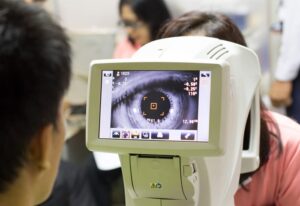
Laser procedures remove corneal tissue to reshape the eye. Your cornea must be thick enough to safely absorb the ablation while leaving a sufficient residual stromal bed. A Pentacam scan maps this precisely before any decision is made.
General Eye Health
Conditions such as keratoconus, uncontrolled glaucoma, severe dry eye, or active eye infections may delay or disqualify surgery. A dilated retinal examination also checks for any peripheral retinal issues that need treatment first.
Overall Health
Uncontrolled diabetes, autoimmune diseases, and pregnancy can all affect healing. These are discussed during your pre-operative consultation so there are no surprises.
The Realistic Timeline: Week by Week
Week 1: Evaluation and Decision
Book a comprehensive eye exam. If you are eligible, your surgeon will recommend the best procedure for your specific corneal anatomy and lifestyle. At Visual Aids Centre, the full assessment — including topography, pachymetry, wavefront analysis, and retinal evaluation — is typically completed in a single visit.
Week 2: Surgery Day
LASIK and SMILE Pro both take under 15 minutes for both eyes combined. You walk in with glasses and walk out without them. Most patients notice significantly clearer vision within hours. Post-operative drops and protective eyewear are provided immediately. The surgical package at Visual Aids Centre includes all pre-operative tests, the procedure, medications, and follow-up visits.
Weeks 3–4: Stabilisation
By the third week, the vast majority of patients are seeing at 6/6 (20/20) or better. You will have follow-up appointments to monitor healing, confirm your visual acuity, and adjust your drop regimen. Minor fluctuations in the first month are normal and typically resolve as the cornea settles into its final shape.
Conclusion
Removing spectacles in one month is not a fantasy — it is a routine clinical outcome for thousands of patients who undergo laser vision correction. The key is understanding that surgery, not shortcuts, is what delivers the result. Eye exercises and dietary changes support general eye health, but they cannot undo a refractive error. If you are serious about life without glasses, the path starts with a proper evaluation to confirm your candidacy and match you with the right procedure. At Visual Aids Centre, we have helped over 250,000 patients make this transition safely. Book your consultation and find out exactly what your one-month timeline looks like.
Frequently Asked Questions (FAQs)
Can spectacles really be removed in one month?
Yes — through laser procedures like LASIK, SMILE Pro, or Contoura Vision. Most patients achieve clear, unaided vision within 24–72 hours of surgery, well within a one-month window.
Can eye exercises remove spectacles permanently?
No. Eye exercises may reduce strain and support general eye health, but they cannot change the physical shape of your eyeball or cornea. Refractive errors require optical or surgical correction.
What is the minimum age for spectacle removal surgery?
The minimum age is 18, though many surgeons recommend waiting until 20–21 when the prescription is more likely to have stabilised.
Which procedure is best for removing spectacles?
It depends on your prescription, corneal thickness, and lifestyle. LASIK, SMILE Pro, Contoura Vision, and TransPRK all deliver excellent results — the right choice is determined during your evaluation.
How much does spectacle removal surgery cost in Delhi?
Costs vary by technology, typically ranging from ₹25,000 to ₹1,00,000 per eye. Visual Aids Centre offers transparent pricing with no hidden charges and flexible EMI options.
Is spectacle removal surgery safe?
Yes. Laser vision correction has a success rate above 96% for achieving 6/6 (20/20) vision. Serious complications are extremely rare when performed by an experienced surgeon with advanced diagnostic technology.
👁️ MEDICALLY REVIEWED BY
Padmashree Dr. Vipin Buckshey
Optometrist & Refractive Surgery Specialist | AIIMS Graduate, 1977 | Padma Shri Honouree
With more than four decades of clinical experience and over 250,000 laser vision correction procedures performed at Visual Aids Centre, Dr. Vipin Buckshey has guided patients across every prescription range through the evaluation, procedure selection, and recovery process. An AIIMS alumnus, former President of the Indian Optometric Association, and official optometrist to the President of India, Dr. Buckshey ensures every patient at the centre receives evidence-based guidance — distinguishing what genuinely works from what does not — before any treatment decision is made. Learn more about our story and the team behind Visual Aids Centre.